
Currently Empty: $0.00
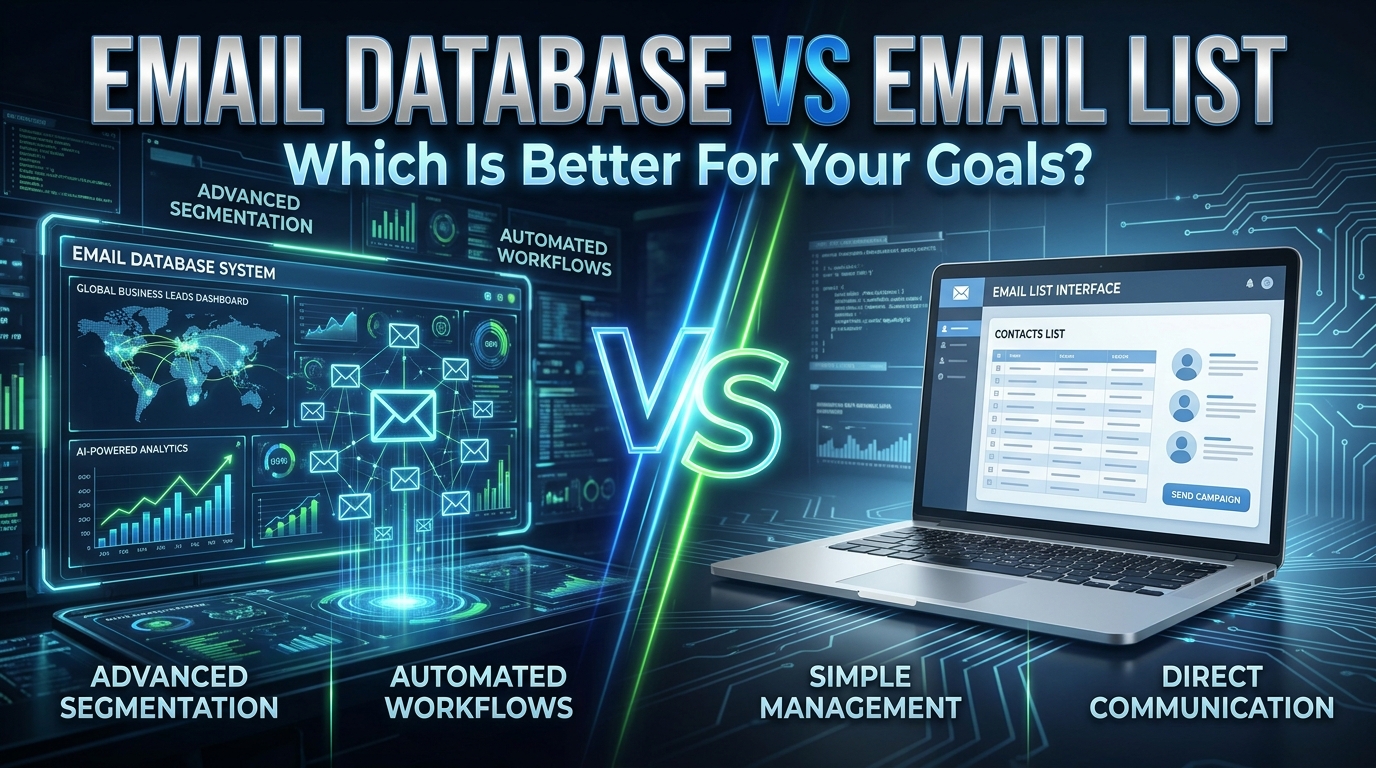
Email Database Vs Email List Difference: Which Is Better For Your Goals
A few years back, I was sitting across from a digital marketing consultant who had just billed a client $3,000 for what she called a “premium email database.” The client was thrilled — until they actually tried to use it.
What they got was a flat CSV file. Name. Email. That’s it. No job titles, no company names, no industry tags, no segmentation of any kind. Just 18,000 rows of names and addresses — an email list dressed up in database clothing, sold at database pricing.
The client’s campaign flopped. The consultant blamed “bad targeting.” But the real problem started way earlier — nobody stopped to ask what the difference between an email database and an email list actually was, and which one that particular campaign actually needed.
That distinction matters more than most people realize. And if you’re about to spend money on contact data for any kind of marketing or outreach, understanding it could save you a lot of wasted budget and frustration.
So What Actually Is an Email List?
An email list is exactly what it sounds like: a collection of email addresses. It might include first names for basic personalization, maybe a last name too. But at its core, it’s a flat, simple structure — a sequence of contacts with minimal attached context.
Email lists are the original format. They’re what newsletter platforms like Mailchimp were built around. Your subscribers opt in, you collect their email address (and maybe their name), and you broadcast content to everyone on that list.
The strength of an email list is simplicity. It’s easy to build, easy to manage, and completely sufficient for certain types of marketing — particularly content-driven newsletters, loyalty programs, and community-based communication where everyone on the list shares a common context.
The weakness: without additional data attached to each contact, you can’t really personalize beyond “Hi [First Name].” You’re speaking to everyone the same way, which works fine when your audience already has a reason to care — and fails completely when they don’t.
And What Makes an Email Database Different?
An email database is structurally richer. It’s not just a list of addresses — it’s a collection of contact records, each with multiple fields of data attached. Think of it like the difference between a sticky note with a phone number and an actual contact card in your phone.
A real email database entry might include:
- Full name and direct email address
- Job title and seniority level
- Company name, size, industry, and revenue range
- Geographic location (country, city, region)
- Technographic data (what tools or platforms they use)
- LinkedIn profile URL
- Phone number (in some cases)
- Engagement or intent signals (in advanced databases)
All of that context is what makes a database genuinely useful for targeted outreach. It’s what allows you to filter down to “SaaS companies with 50–200 employees, where the contact is a Head of Marketing, located in the US” — and send a message that speaks directly to that specific profile.
An email list can’t do that. An email database can. That’s the core difference.
A Side-by-Side Look at the Key Differences
Email List
- Flat structure — email + name only
- Best for opt-in audiences
- Simple to manage and export
- Limited personalization options
- Works with newsletter platforms
- Lower cost to acquire
- Ideal for broadcast communication
Email Database
- Rich records — many data fields
- Built for targeted cold outreach
- Filterable and segmentable
- Deep personalization possible
- Requires cold email platforms
- Higher cost, higher value
- Ideal for precision B2B outreach
Where People Get Confused — And Why It Costs Them
The marketing world uses “email list” and “email database” almost interchangeably — which is where the confusion starts. Vendors selling scraped contact data will call their product a “database” because it sounds more premium. Buyers assume they’re getting something sophisticated. They’re often not.
I’ve seen this play out in three specific ways:
Wrong tool, wrong use case. Someone building a cold outreach campaign buys an “email list” when they needed a database. They have no way to filter by industry or job title. They blast everyone with the same message and get 0.8% open rates and a wave of spam complaints.
Overpaying for complexity they don’t need. Someone running a simple newsletter buys a full-featured B2B database at premium pricing. All the extra fields — company size, technographics, revenue data — go completely unused. They needed a list. They paid for a database.
Platform mismatch. Someone imports a purchased database into Mailchimp or ConvertKit — which are designed for permission-based lists — and gets their account suspended. Those platforms aren’t built for cold contact data. The data type and the platform need to match.
Which One Is Actually Better for Your Goals?
Neither is universally better. The right choice depends entirely on what you’re trying to accomplish. Here’s how to think through it honestly:
Use an email list when:
- You’re running a newsletter or content publication with an established audience
- Your contacts have already opted in and share a clear common interest
- You’re doing broadcast-style communication — announcements, promotions, updates
- You’re building a community around a brand or product people already know
- Your message is the same for everyone and personalization beyond first name isn’t needed
Use an email database when:
- You’re doing B2B cold outreach to people who’ve never heard of you
- You need to filter contacts by job title, company size, industry, or geography
- Your value proposition is specific to a particular role or company type
- You’re running account-based marketing (ABM) campaigns targeting named companies
- You need to personalize beyond first name — referencing company, industry, or role context
The simplest way to decide: if your message is the same for every recipient, an email list is probably sufficient. If your message needs to change based on who the recipient is and what they do, you need a database.
What This Looks Like in Practice
Let me give you two real-world scenarios that illustrate the difference clearly.
Scenario one: the SaaS founder doing cold outreach
A bootstrapped SaaS founder wants to reach operations managers at logistics companies with 100–500 employees in the US. She has a specific pain point she solves, a specific title she’s targeting, and specific company attributes that signal fit.
She needs an email database — specifically one that lets her filter by job title, industry, and company size. She pulls 400 contacts from Apollo, verifies them through ZeroBounce, and sends a cold sequence through Instantly. Her open rate is 47%. She books 6 calls in the first two weeks.
An email list of 10,000 generic “business professionals” would have given her none of that targeting capability. She’d have wasted money and time on people who were completely irrelevant to her offer.
Scenario two: the content creator building a newsletter
A marketing blogger wants to grow her weekly newsletter about growth marketing. She runs lead magnets, optimizes her opt-in forms, and drives subscribers through organic content. Those subscribers become her email list. She sends the same newsletter to everyone — same content, same format, same voice. The list format is perfect for this. A complex B2B database with 40 data fields per contact would add zero value and significant overhead to a simple broadcast workflow.
The Data Quality Question Nobody Talks About Enough
Here’s something worth knowing: an email database is only as good as the data attached to each record. And that data degrades fast.
People change jobs. Companies pivot. Titles shift. A “VP of Marketing” at a company in January might be “Head of Growth” at a completely different company by September. B2B contact data has an estimated annual decay rate of around 25–30% — meaning roughly a quarter of your database becomes inaccurate every twelve months.
This is why database providers that continuously verify and refresh their data — like Cognism, which phone-verifies mobile numbers, or Apollo, which crowdsources data updates from its user base — produce meaningfully better results than static dumps bought once and never updated.
An email list decays too, but more slowly — people change email addresses less often than they change jobs. If you’ve built your list organically through opt-ins, re-engagement campaigns and regular sending frequency do most of the hygiene work naturally.
The Compliance Angle Changes Too
Email lists and email databases also carry different compliance profiles — another thing that almost never gets discussed when people compare the two.
An opt-in email list — built through your own sign-up forms, lead magnets, or checkout flows — is the cleanest compliance position you can have. Those people explicitly asked to hear from you. CAN-SPAM, GDPR, CASL — your exposure across all of them is minimal when consent is documented and real.
A purchased email database is a different story. You’re contacting people who didn’t ask to hear from you. In the US, for B2B cold outreach, that’s generally permissible under CAN-SPAM as long as you follow the rules. In the EU, the picture is murkier — GDPR’s legitimate interest basis can be argued for genuine B2B outreach, but it requires documentation and a clear opt-out mechanism. In Canada under CASL, the bar is highest of all.
The practical implication: if compliance is a serious concern for your business — regulated industries, international markets, enterprise clients who scrutinize your data practices — opt-in list building is always the safer path. Purchased databases require more careful legal positioning.
Can You Use Both at the Same Time?
Yes — and mature marketing operations usually do.
The typical playbook looks like this: use a purchased email database for top-of-funnel cold outreach — reaching new prospects who’ve never heard of you. When those cold prospects convert to any kind of opt-in (requesting content, signing up for a trial, booking a call), they move into your email list and enter a different nurture workflow.
The database generates new conversations. The list deepens existing relationships. They serve different stages of the same funnel, and they use different platforms, different compliance frameworks, and different copywriting approaches.
Conflating them — treating cold database contacts as if they’re warm list subscribers, or managing an opt-in list with cold outreach tools — is where things break down. Keep them separate, both in your thinking and in your tooling.
Common Mistakes When People Mix Up the Two
Importing purchased database contacts into Mailchimp or ConvertKit. These platforms are permission-based. Their terms of service prohibit sending to contacts who haven’t opted in. You will get suspended. Use Instantly, Lemlist, Smartlead, or Woodpecker for cold database outreach.
Sending newsletter-style content to a cold database. People on a purchased database didn’t subscribe to your content. Sending them a newsletter they never asked for generates spam complaints fast. Cold database outreach needs to be short, personal, and focused on a single conversation-starting ask — not a content digest.
Assuming a “database” label means quality data. Always ask what fields are included, how frequently the data is refreshed, and whether email addresses are verified. A flat CSV with name and email and no other fields is a list, not a database — regardless of what the seller calls it.
Building only one or the other. Long-term, you want both. The database feeds your top of funnel. The list deepens your relationship with people already in your orbit. Relying exclusively on cold databases means you’re always paying to reach strangers. Relying exclusively on an opt-in list limits your reach to people who already know you exist.
Quick Reference: Matching Format to Goal
Your goal
Cold B2B lead generation
Newsletter / content marketing
Account-based marketing (ABM)
Loyalty & retention campaigns
Top-of-funnel prospecting
Community building
Use this
Email database
Email list
Email database
Email list
Email database
Email list
The Bottom Line
The email database vs. email list debate isn’t really about which one is better. It’s about which one is right for what you’re specifically trying to do. They’re different tools for different jobs — like comparing a scalpel to a broadcast antenna. One isn’t superior. They just operate in completely different contexts.
If you’re doing targeted B2B outreach and you need to reach specific titles at specific types of companies — you need a database with rich, filterable data and the infrastructure to use it properly. If you’re building an audience around content or a brand that people already opt into — a well-maintained email list is your most valuable long-term asset.
The $3,000 “premium database” that turned out to be a flat list of names and emails? That campaign failed because the buyer didn’t know the difference — and the seller was counting on that. Now you know. Choose accordingly.