
Currently Empty: $0.00
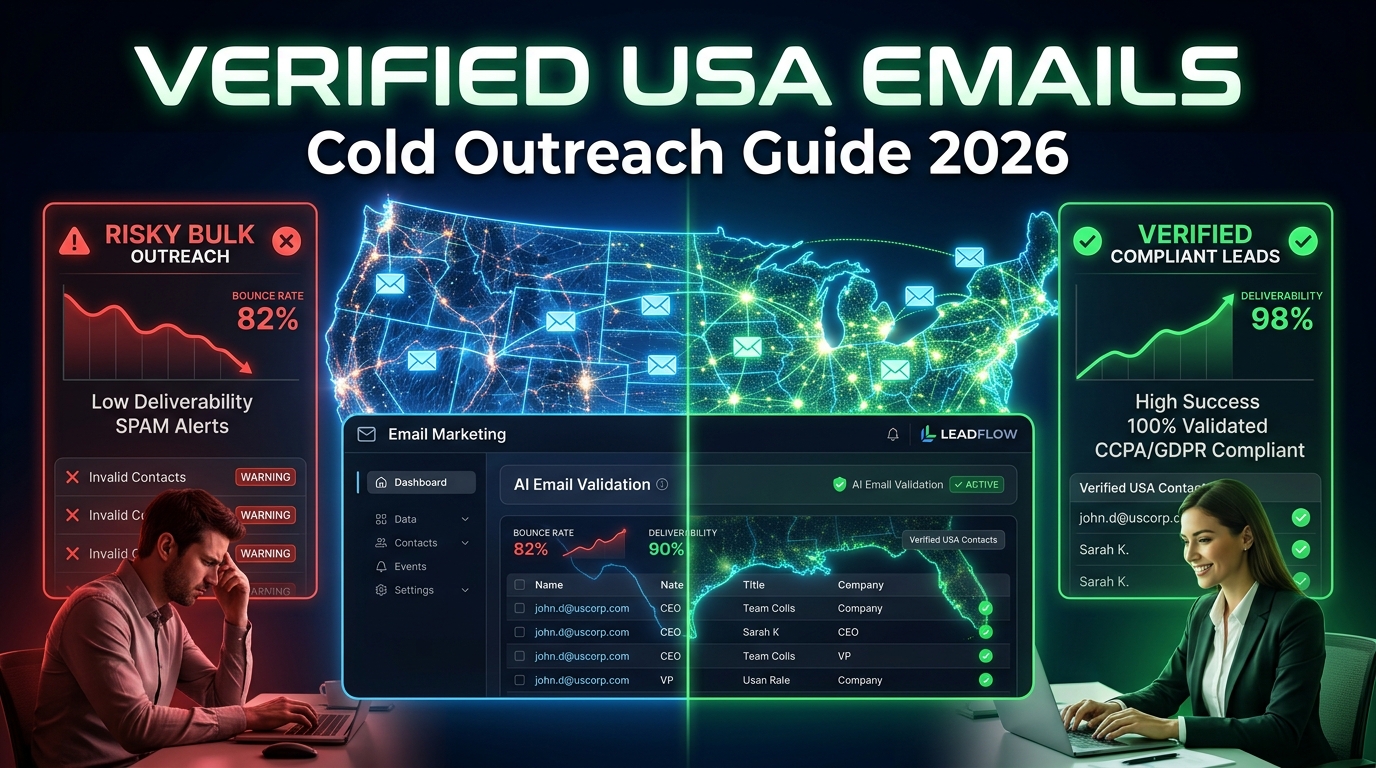
Verified USA Email Addresses For Cold Outreach To Skyrocket Your Sales
Nobody warns you about the silence.
You spend hours building a cold email campaign. You agonize over the subject line. You rewrite the opening sentence six times. You set up the sequence, schedule the sends, and then you wait.
Nothing.
Not angry replies. Not unsubscribes. Just nothing. Open rates so low they look like a rounding error. Zero replies across 3,000 sends.
The first time this happened to me, I assumed my copy was terrible. So I rewrote everything and tried again. Still nothing. Then I finally did what I should have done before touching the copy at all — I ran the list through an email verifier.
Forty-one percent of the addresses were invalid.
I had spent two weeks crafting emails that were never going to land in anyone’s inbox. The problem wasn’t my copy. It was that I was shouting into a void of dead email addresses, and my domain reputation was quietly absorbing the damage with every bounce.
That day changed how I approach every single outreach campaign. Verification stopped being an afterthought and became the foundation. And when I finally ran campaigns built entirely on verified USA email addresses, the results weren’t just better — they were in a completely different category.
Here’s everything you need to know to do this right.
Why “Verified” Is the Most Important Word in Cold Outreach
The cold email world throws around a lot of words that sound important but mean very little in practice. “Targeted.” “Curated.” “Premium.” “Enriched.” Most of them are marketing language dressed up to justify a price tag.
“Verified” is different. It has a specific, testable meaning — and whether your email addresses are verified or not is one of the most consequential variables in your entire outreach operation.
Here’s why it matters so much.
When you send an email to an invalid address, you get a bounce. One bounce is harmless. But bounces accumulate. Email service providers — Gmail, Outlook, Yahoo — monitor the bounce rates of every sending domain they process. When your bounce rate climbs above 2–3%, you start getting flagged. Above 5%, you’re looking at serious deliverability damage. Above 10%, some ESPs will suspend your account outright.
But here’s the thing most people don’t realize: the damage doesn’t reset when you stop sending to bad addresses. Your domain’s reputation is a score that moves slowly in both directions. Burning it with a high-bounce campaign can take months of careful sending to repair. And during those months, even your emails to valid, engaged contacts are landing in spam.
Verified addresses protect you from this entire cascade. They’re the difference between a cold outreach operation that compounds over time and one that burns itself out every few months.
What Email Verification Actually Does (The Technical Part, Made Simple)
There are three levels of email verification, and understanding them helps you evaluate any tool or list vendor’s claims.
Level 1 — Syntax Check This confirms the email address is formatted correctly. Does it have an @ symbol? A domain? A valid TLD? sarah@acmecorp.com passes. sarah@acmecorp fails. sarahacmecorp.com fails.
This is the bare minimum. Any tool that only does syntax checking and calls itself a “verifier” is overstating its value significantly. Syntax-valid emails can still be completely dead.
Level 2 — Domain Check This confirms the domain exists and has active mail exchange (MX) records configured. acmecorp.com either has an email server set up or it doesn’t. If it doesn’t, every address at that domain is invalid regardless of syntax.
This filters out a lot more garbage — defunct companies, mistyped domains, placeholder addresses. Better than syntax-only, still not sufficient on its own.
Level 3 — SMTP Verification This is real verification. The tool connects to the mail server at the target domain and asks, at the protocol level, whether the specific mailbox exists. It gets a response: yes, this mailbox exists; or no, it doesn’t. No email is actually sent during this process — it’s a handshake that stops before delivery.
SMTP verification is what separates genuinely verified addresses from merely formatted ones. When a reputable vendor tells you their list is “verified,” they should mean SMTP-verified. If they can’t tell you which method they use, assume it’s syntax-only.
One important caveat: catch-all domains. Some organizations configure their mail servers to accept email to any address at their domain, whether or not the specific mailbox exists. anythingwhatsoever@bigcorp.com would technically “verify” at SMTP level because the server says yes to everything. These catch-all addresses require a judgment call — for established companies with professional domains, they’re often worth including. For less identifiable domains, they’re higher risk.
Where to Get Verified USA Email Addresses
This is the part where I give you the honest rundown — no affiliate relationships, no sponsored placements, just what I’ve actually tested.
Apollo.io — Best Overall for USA B2B Verified Contacts
Apollo maintains a database of 270+ million contacts with continuous verification. When you export a list from Apollo, the addresses have been through their verification pipeline, which includes SMTP-level checks. Their published data accuracy guarantee is around 95% valid on export.
In practice, from dozens of Apollo exports I’ve tested against ZeroBounce, I typically see 92–96% valid addresses. That’s genuinely good for a database at this scale.
The filtering for USA-specific outreach is excellent. You can target by state, metro area, company size, industry, revenue range, job title, seniority level, and even technographic signals like which CRM or marketing tool a company uses. This precision means you’re not just getting verified addresses — you’re getting verified addresses of people who actually match your buyer profile.
Pricing: Free plan with 50 monthly credits. Paid from $49/month.
Best for: Any B2B cold outreach targeting US professionals. My first recommendation for most teams.
ZoomInfo — Highest Accuracy, Premium Price
ZoomInfo is the Rolls Royce of B2B contact data. Their verification processes are rigorous, their data refresh rates are high, and their coverage of US businesses is the most comprehensive available. When accuracy is the non-negotiable priority, ZoomInfo delivers.
The catch is cost. Enterprise pricing starts around $15,000/year. Their SMB tiers are cheaper but still represent a significant investment. The ROI calculation works if your average deal size is substantial — if you’re closing $50,000+ contracts, verified ZoomInfo data pays for itself quickly. If you’re selling a $99/month SaaS product, the math is harder to justify.
Best for: Enterprise sales teams with large deal sizes where data accuracy directly impacts revenue at scale.
Cognism — Strong on Compliance + Verification
Cognism differentiates itself on two things: data accuracy and compliance documentation. Their Diamond Data tier provides phone-verified mobile numbers alongside email — someone actually called the number to confirm the person is still at the company. That’s a level of verification that goes beyond anything digital tools can do automatically.
For USA B2B outreach, their email data is solid and they maintain detailed documentation of data sources and consent basis — useful if you’re operating in regulated industries or need to demonstrate compliance practices to clients.
Pricing is custom/quote-based, generally positioning between Apollo and ZoomInfo.
Best for: Teams in regulated industries, agencies that need compliance documentation, or outbound operations combining email and phone.
Hunter.io — Verified Emails at Specific Companies
Hunter works differently from the above. Rather than browsing a database, you input a company domain and Hunter returns verified email addresses it has found associated with that domain, along with a confidence score for each address.
The verification is real — Hunter shows you not just the email pattern but individual addresses that have been confirmed as deliverable. The confidence score reflects how many sources they’ve found the address on and whether it passed their verification checks.
This is precision tooling. You need to already know which companies you’re targeting. But if you have a target account list — even 100 or 200 companies — Hunter is extraordinarily cost-effective for finding verified contacts at each one.
Free: 25 searches/month. Paid from $34/month.
Best for: Account-based outreach to a predefined list of target companies.
Lusha — Verified Email + Phone, Good for SDR Teams
Lusha provides verified B2B contact data with an emphasis on direct dials alongside email. Their verification includes both email and phone checks. The Chrome extension makes it easy to pull verified contact data directly from LinkedIn profiles while browsing.
For SDR teams running multi-channel outreach — email sequences backed up with phone calls — Lusha’s verified data in both channels is genuinely useful. Data quality is consistently solid for US mid-market and enterprise contacts.
Free: 5 credits/month. Paid from $36/month per user.
Best for: SDR teams running phone + email outreach who need both channels verified.
Buy Vietnam Email Database — 1.2 Million Verified Email Addresses
Running Your Own Verification: The DIY Approach
If you already have a list — purchased, scraped, manually researched, or pulled from an old CRM export — you can verify it yourself using dedicated verification tools.
ZeroBounce — My go-to. Exceptionally detailed results: valid, invalid, catch-all, abuse, spam trap, temporary/disposable, and unknown. The spam trap detection is particularly valuable — if your list contains known spam trap addresses, ZeroBounce flags them so you can remove them before they crater your sender score. Pricing from $15 for 2,000 verifications.
NeverBounce — Fast, reliable, good bulk pricing. Pay-as-you-go at $0.008 per verification. Real-time API available for in-app verification. Slightly less detailed categorization than ZeroBounce but consistently accurate on the valid/invalid determination.
MillionVerifier — The budget option. Accuracy is good but the detailed categorization is more limited. For very high-volume verification where cost per record matters, it’s worth considering.
Bouncer — Particularly strong at catch-all detection and filtering risky addresses. Worth testing if catch-alls are a significant portion of your list.
The threshold I use: After verification, if more than 5% of addresses are invalid, I do not send to that list without re-sourcing the data. A list with 95%+ valid addresses after verification is campaign-ready. Anything below that needs investigation.
Building a Verified USA Email List From Scratch: Step-by-Step
If you’re starting from zero, here’s the workflow I’d follow today to build a high-quality verified list of US email addresses for cold outreach.
Step 1 — Define Your ICP With Specificity
Ideal Customer Profile work isn’t glamorous but it determines everything downstream. Before touching any tool, document:
- Industry (be specific — not “tech” but “B2B SaaS companies with self-serve products”)
- Company size by employee count and/or revenue
- Geography (all US? specific states or metros?)
- Job titles and seniority of the decision-maker you want to reach
- Any technographic or firmographic signals that indicate a good fit
The narrower your ICP, the smaller your initial list — and the higher your conversion rates. A verified list of 500 perfectly matched contacts will outperform a verified list of 5,000 loosely matched contacts in almost every scenario.
Step 2 — Source From a Verified Database
With your ICP defined, open Apollo (or whichever sourcing tool fits your budget) and build a search that matches your criteria. Filter down until you’re looking at a segment that feels genuinely targeted rather than just large.
Export in batches rather than one massive pull. 500–1,000 contacts at a time is manageable, lets you test messaging before scaling, and keeps your import process clean.
Step 3 — Run Verification Even on “Pre-Verified” Lists
Even if Apollo or another platform tells you the addresses are verified, run them through ZeroBounce or NeverBounce before importing into your sending tool. Database verification and real-time verification don’t always agree, and the 10–20 minutes this takes is worth the protection.
Remove all invalid and abuse-flagged addresses. Make a judgment call on catch-alls based on domain quality.
Step 4 — Enrich Missing Fields
After verification, look at what enrichment fields you’re missing. If 30% of contacts are missing company name, or 20% are missing state — fields you need for personalization or segmentation — consider running those records through a tool like Clearbit Enrichment or Apollo’s enrichment feature to fill the gaps before building your sequences.
Step 5 — Segment Before Import
Split your verified list by at least one meaningful dimension before it enters your sending platform. Industry, company size, job seniority, and US region are the most commonly useful splits. Create a separate CSV for each segment. Import each one into its own list or tag in your email platform.
Step 6 — Set Up Domain Infrastructure
This step exists because cold outreach to purchased lists should never happen from your primary business domain. Set up a sending domain — something like tryacmecorp.com or getacme.co — with proper SPF, DKIM, and DMARC authentication. Warm it up for 3–4 weeks using a tool like Lemwarm or Instantly’s warm-up feature before sending any cold email. Protect your main domain from any deliverability impact.
Step 7 — Build and Send Your Sequence
Now — and only now — are you ready to write and send. Everything above was infrastructure. This is where the outreach actually happens.
Cold Email Sequences That Actually Convert Verified Lists
Having a verified list is necessary but not sufficient. The sequence you build determines whether verified contacts become conversations.
Subject Lines That Get Opens
For USA B2B cold outreach, the subject lines that consistently outperform are specific, low-friction, and slightly curious rather than salesy:
Quick question for [Company][First Name] — idea for [specific problem]Saw you're hiring [role] — thought this might help[Mutual connection] suggested I reach out[Company] + [Your Company] — worth 15 mins?
Generic subject lines like “Grow your business” or “Partnership opportunity” have been trained into spam recognition by years of overuse. Specificity is the differentiator.
Buy VPN User Email List – 3.1 Million Verified VPN Users Email Database
Email 1 — The Opener
Short. Under 100 words ideally. One observation, one question, zero hard pitch.
The formula that works: Relevance signal + Problem acknowledgment + Single question.
“I noticed [Company] recently [specific thing — new hire, funding, product launch, expansion]. We work with [similar companies] to [solve specific problem]. Would it be worth a quick chat to see if we could do the same for you?”
The relevance signal shows you didn’t just buy a list and blast everyone. The problem acknowledgment connects to something they care about. The single question has a yes/no answer, which lowers the decision threshold for replying.
Email 2 — Day 3–4, The Value Add
Don’t just follow up saying “just checking in.” That phrase generates eye-rolls at scale.
Add something: a relevant stat, a brief case study result, a piece of content that’s genuinely useful for someone in their role. Give them a reason to engage beyond your need for a reply.
“Following up from Monday — also wanted to share this: [one sentence describing the value]. Might be relevant given what [Company] is working on.”
Email 3 — Day 8–10, The Easy Out
The third email exists for the people who were interested but kept forgetting to reply. Give them permission to disengage or a low-friction way to stay connected.
“Last note from me — completely understand if the timing’s off. If this becomes more relevant down the road, happy to reconnect. Just let me know.”
This consistently generates replies — people respond to being given an easy exit. “Actually, let’s talk in Q3” is a pipeline entry, not a rejection.
Email 4 (Optional) — Day 18–21, The Re-Angle
For high-value targets, a fourth touch from a completely different angle can unlock conversations that the first sequence didn’t. Reference something new — a recent piece of their content, an industry development, a different problem you can solve. Don’t repeat yourself. Come in fresh.
Deliverability: Protecting Your Investment in Verified Data
Verified addresses protect your deliverability. But they don’t guarantee it. Here’s what else to monitor.
Sending volume ramp — Even with a warmed domain, don’t go from 0 to 500 sends per day overnight. Increase volume gradually — 50/day for week one, 100/day for week two, scaling from there as metrics stay healthy.
Reply rate as a health signal — A reply rate above 3% on a cold campaign generally indicates healthy deliverability and reasonable message-market fit. Under 1% consistently warrants investigation — either the emails aren’t reaching inboxes or the message isn’t resonating.
Google Postmaster Tools — Free, authoritative insight into how Gmail is treating your sending domain. Set this up before your first send and check it weekly. The domain reputation and spam rate dashboards are the earliest warning system available.
Complaint rate — Keep this under 0.1%. Even one spam report per thousand emails starts accumulating damage. If a particular segment generates complaints, pause it and investigate whether the targeting or messaging is the issue.
Bounce rate in real time — Set alerts in your sending platform for bounce rate. If it crosses 3%, pause the campaign. Something is wrong — either the verification missed more than expected or a segment of the list is older than the others.
The Compounding Effect Nobody Talks About
Here’s the thing about building outreach on verified USA email addresses that most articles don’t cover: the benefits compound over time in a way that unverified list outreach never can.
When you maintain a verified list, update it after each campaign, remove bounces immediately, and re-verify segments before reuse — the list actually improves with each campaign cycle. Your domain reputation stays healthy. Your deliverability across all email, not just cold outreach, benefits from the clean sending history. Your team develops real insight into which segments respond to which messages.
Compare that to the other approach: buy a cheap list, blast it, burn the domain, start over. That cycle never builds anything. Each campaign is isolated. Nothing compounds.
The marketers I know who are genuinely scaling revenue through cold email aren’t the ones with the biggest lists. They’re the ones maintaining the cleanest lists, running the most targeted campaigns, and treating verification not as a one-time step but as an ongoing operational discipline.
That discipline is what turns cold outreach from a revenue gamble into a reliable, scalable channel.
It starts with verified addresses. Everything else builds on top of that foundation.